Available Immediately: Home for Heinzelmann Family
Years before we built our earthen house, we bought a carved stone alcove in anticipation. We eventually embedded it in the northeast corner of the living room, where it waited even more years for the next thing to happen.
The next thing was to furnish the alcove for a Heinzelmann. Heinzelmännchen (that’s more than one Heinzelmann) are German elves or spirits that come in at night to finish the chores that don’t get done during the day. They are mostly associated with the city of Cologne (Köln), where the townspeople messed up and lost their Heinzelmännchen forever.
In hopes of welcoming a Heinzelmann family to our home, I furnished the alcove with a crocheted rug, two pillows, and a basket with a light blanket.


The light blanket seemed too thin for winter, so I knitted a garter stitch blanket with the thinnest needles and finest wool in my collection. It was handspun, but not by me.

Spring rolled around. The woolen blanket was stored away, and we added a potted plant constructed with a wooden hot sauce lid and a rolled up green leafy decoration from a sushi meal. For winter, we brought the blanket out again and exchanged the plant for a china vase.


No evidence suggests that our cozy alcove has attracted a Heinzelmann family to our house. Yet.
Read a story about Heinzelmännchen, with sweet pictures, at German Girl in America.
The rug, pillows, and basket were crocheted with No. 10 crochet cotton.
Snowflakes Create Avalanches

Early voting for the 2026 midterm election started yesterday in Texas and quite a few more states. Charles and I voted this morning. My fellow U. S. Citizens, have you voted yet? If so—yay! If not, look up where your polling place is and when it is open, decide when you are going to vote, and do it.
But you might worry that your vote won’t matter. Well, of course it matters!
In rural Texas, a candidate can be elected to office by a one-vote margin. Let’s say seven people vote in a two-candidate race for a position on the local schoolboard. When one candidate gets four votes, that candidate wins—by one vote. It happens. Never assume your vote doesn’t matter, even if you don’t live in rural Texas.
When a candidate wins by a great majority, we traditionally refer to that win as a “landslide.” In the late 2010s, “snowflake” was a name used to describe people who cared about our beautiful Earth, and about the health and rights of others. Poor snowflakes—so delicate, so liable to melt in the slightest puff of breath.
But when enough snowflakes move together, they create avalanches. An avalanche is like a landslide, only it is made of snow instead of mud. That is what this quilt, Snowflakes Create Avalanches, is about.

The crocheted snowflakes in this piece were made by my mother, Anna Wirth Thompson, by me, and by unknown crocheters.
Snowflakes Create Avalanches was finished in 2019. Techniques used were patchwork, quilting, crochet, and embellishment. Materials used were cotton fabric and thread, buttons, and beads.
Halloween Crochet
Two of my friends love Halloween.
It wouldn’t be going too far out on a limb to claim that Alissa has more Halloween decorations than decorations for Christmas. She is fond of the skeleton aesthetic. During COVID times, my daughters stayed in her house for a short vacation. They were surprised to find a skeleton in the kitchen, reaching out to open the fridge.
My friend Peggy likes witches. She pieced together and embellished a collection of stunning Halloween-themed quilts featuring witches. When I say she pieced together a collection of quilts, I mean she got out fabric, cut it up, and pieced it back together to form quilt tops.
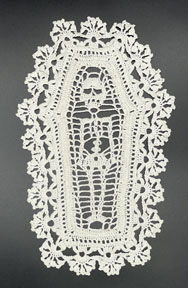
Last year I crocheted a Halloween gift for each of them. The skeleton doily is “Postmortem” by Ann Wanamaker. It’s so gruesome and surprisingly delicate-looking, I couldn’t stop with just one. Now we have a Postmortem doily at our house, too. Ann has lots of skull and skeleton crochet designs, which you can see on her designer page on Ravelry.
The witch is from the pattern “Ms. Mum Crinoline Girl Doily” by Cylinda Mathews. Cylinda designed a different crinoline lady for each month of the year. I changed the colors and altered the Ms. Mum pattern here and there to fit my vision of a crinoline-style witch.

Both doilies were fun to make, especially because I knew Alissa and Peggy would appreciate them. Postmortem arrived at Alissa’s in time to be displayed during a tour of homes. The witchy Crinoline Girl features in the newest addition to Peggy’s witchy quilt collection. Its title is History Repeated, pieced and embellished by Peggy DeLaVergne, quilted by Claire McConn.


Last Year at This Time: Flowery Crocheted Bookmarks
About one year ago, I did the last bit of admin work (sending an invoice) for Quarto Publishers, who published a little book of eleven of my crocheted flower bookmarks as part of a crochet kit called Crochet Botanical Bookmarks.

The time between contract and deadline was short, so I ignored all other projects to design and crochet bookmarks for about three whirlwind weeks. Aside from the actual designs and written patterns, I was responsible for providing step-by-step photos. That was actually great, because it gave me an opportunity to re-crochet and re-proofread my patterns.
My editor and I were in touch during the process. She made suggestions, and I adjusted designs accordingly.

I enjoyed the challenge of distilling a flower design into a small size, while keeping it recognizable. Coming up with finial designs was fun, too. They are the little doodads at the end of the stem, opposite of the flower, that keep the bookmark from sliding out of the book. Crocheters can use the suggested finial for each flower, or the finial of their choice.
Once I finished my part of the job, the long wait began. Months later, in the spring of 2026, I saw an ad for Crochet Botanical Bookmarks. So exciting! A few weeks after that, my author copies arrived in the mail. This was the first time I was involved in designing for a kit, so it was even more exciting to open the box. The kit contained five colors of yarn, a crochet hook, a yarn needle, and a book with crochet instructions, step-by-step photos, and more.

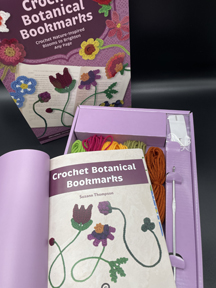
Crochet Botanical Bookmarks is available to buy direct from Quarto, and from other fine online or brick-and-mortar retailers.
Celebrate Doilies and Texas Crochet Heritage Exhibits at Rockport

In March and April 2026, Texas Crochet Heritage and Celebrate Doilies were the first exhibits ever in the brand new Aransas County Community Center on N. Live Oak Street in Rockport, Texas. Exciting times!

Jennifer Day of the Rockport Cultural Arts District, along with her talented colleague, Pam, decided to display the panels of Texas Crochet Heritage on table-top easels. The exhibit has forty-five panels in all. Community quilts and family heirlooms from Rockport added color and a touch of home to the exhibits.


Pam spent a great deal of time working out how to display my quilts on wall-panels to their best advantage. “Arranging art exhibits used to be my superpower,” she told me. Pam. It still is your superpower.

On the exhibits’ last day, Sandi Horton and I gave our Crochet Connections presentation. It’s a slide show with music, where we talk about how crochet connects people over time and miles. Some connections seem almost spiritual. There’s one doily story in which I can’t quite decide what is happening. I asked the audience, “What do you call this? Coincidence? Synchronicity? Or what?” A lady in the audience exclaimed, “That was destiny!”

Taking down the exhibit was way quicker than putting it up. So not long after our talk, Sandi and I were on the road with a car full of quilts. We stopped for lunch before heading on to our rendezvous with Sandi’s husband. Then I drove alone for another couple of hours and arrived home before dark.
Very Bright Spots at Ella’s
The year 2020 was like no other in our lives. Many died. Many of the rest of us were lucky (?) enough to stay home to try and avoid catching the COVID virus.
My husband Charles went to work, because completing his geoarchaeological work was considered essential for state and federally-funded projects, like dams and roads, to proceed. Our daughter Eva started a new job in the northeast and worked for about three weeks before employees were sent away from the office to work from home. Our daughter Ella, a junior in high school, was enjoying her spring break, when the school phoned students to announce the break would be extended for another week. Maybe by then, they reasoned, the COVID scare would be over. She and her classmates didn’t return to school in person for the rest of the 2020 and beyond.
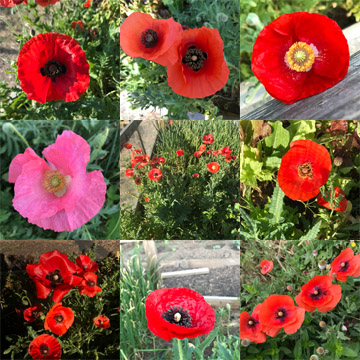
At our place, Charles sprinkled poppy seeds in his vegetable garden. They sprouted and bloomed beautifully. Ella and I went out frequently to admire them and take pictures. The poppies were a very bright spot during those dark and stressful times.
One of the poppy photos inspired a TextileFusion wall hanging for Ella. Its title was A Very Bright Spot in 2020. (Ella’s elder sister Eva already had a wall hanging by me, called Fishy Cento.)
A Very Bright Spot in 2020 followed Ella to the university dorm and to a couple of different apartments, to land most recently at a sweet house that she and a friend are sharing. The family got to see Ella’s new place over the weekend. I noticed two very bright spots. First, the wall hanging:

…and second, doilies and more doilies:

I’m very, very happy that my daughters love crochet and knitting!
Doily Heaven in Lampasas
The Trading Post, a good sized antique mall in Lampasas, Texas, has doilies all over the place! It seemed to me like an organized effort by the vendors there, to put their antique and vintage lamps, candlesticks, vases, and china on doilies. It was so pretty!

This checkerboard crochet doily was in, like, the third booth I walked into. “Better take a picture, otherwise there might not be enough doilies to blog about,” I thought.


I needn’t have worried because, like I said, the doilies were plentiful. There was even a knitted one. Finally, I came across the vintage linens booth, and sorted through the basket full of doilies and some other thread creations. It was a good visit.

The Trading Post is at 406 S. Live Oak Street, across from the County Courthouse in Lampasas, Texas. It has a long mural above the entrance.

It’s Time to Register!

It’s time to register to vote!
…unless you are already registered, of course. In that case, YAY!!!
In Texas, our deadline to register to vote in the November 2026 midterm election is October 5, 2026. If you are already registered in Texas, it’s a good idea to confirm your registration by visiting VOTETEXAS.GOV, and find the link to “Am I Registered?” in the third paragraph. VOTETEXAS.GOV is an official website of the Texas Secretary of State.
Some important dates for Texas voters:
- Deadline to register to vote: October 5, 2026
-
Early voting starts: Monday, October 19, 2026
-
Deadline for vote-by-mail applications to arrive at county elections office: Friday, October 23, 2026. If you want a mail-in ballot, request one now. More information at Voting By Mail at VOTETEXAS.GOV.
-
Last day to vote early in person: Friday, October 30, 2026
-
Election Day: November 3, 2026
I’m not familiar with voter registration in other states, but you should be able to find out online by searching how to register to vote in your state.
The quilt pictured here is called What to Do in a Democracy. I made it in 2019 to liven up our voter registration booths at various locations around the county.
Read more about the quilt at this blog post. It shows a closeup of the “O” made from a crocheted edging.
Crochet Treasures in England
My little family moved from Texas to the City of Sheffield, England, in 1996, and back to Texas in 2003. This past May, we finally returned to Sheffield for a visit. It was a sweet homecoming. We walked and walked around the Sheffield neighborhoods and surrounding countryside, enjoying the cool days. I wondered why we ever left!
We visited friends, the old neighborhood, the Peak District, the seaside, and the charity shops. Ah the charity shops! I have missed them. They are thrift shops, with the proceeds going to certain causes. They are usually named after the whatever charity they support, like St. Luke’s Charity Shop, which benefits St. Luke’s Hospice. Our house in Sheffield was near the St. Luke’s Charity Shop on Abbeydale Road. We visited pretty often, back then. Once, I brought a good many mother-of-pearl buttons up to the register at St. Luke’s. The cashier told me they would be more expensive, because they were not just your run of the mill buttons. I braced myself. She quoted a price. I paid it gladly, because even at the mother-of-pearl price, the buttons were very affordable.

This year I found crocheted treasures at the Sheffield Cats Shelter Charity Shop. The first one had flower and leaf designs, associated in my mind with Irish Crochet. It was so unusual, I had to take it home. I’m calling it the Irish-ish Table Mat.

Further down in the stack of handmade items, was a rare crochet piece. The pattern was geometric, crocheted in long rows, some of which had short fringe on the ends.

It was rare, because it had a maker’s label on it. Even more interesting, the initials “E. F.” are both my daughters’ initials! Yes, that one came home with me, too.

Later that day we drove to the town of Tideswell in the Peak District to visit Peak District Yarns, for a little shopping. Browsing through their hand-dyed yarns was a pleasure.
It was a short walk from the yarn store to Peak Volumes, a used book store in an old bank building with a pleasing mosaic floor in the entryway. I headed for the craft section. There was a book about 9 inches tall with a raggedy spine. It looked promising. I pulled it off the shelf for a look. My heart filled with joy when I saw that it was an original copy of Artistic Crochet, edited by Flora Klickmann. She was a prolific writer and editor of books about home arts and more. It came back with me to Texas in my carry-on bag.

Luckily, we can view, download, or print the complete Artistic Crochet, edited by Flora Klickmann, starting with the overview page at Antique Pattern Library: Artistic Crochet. To download or print, click the PDF option in the title box near the top of the page.
Highlights from our trip are posted on Instagram, @suzannthompson, May 16 – July 5, 2026.
His & Hers Pillowcases with Crochet

I decided to see what I could find online about His & Hers pillowcases, after running across a HER pillowcase at the charming Comanche Mercantile store in Comanche, Texas. I had seen embroidered versions of His & Hers pillowcases, but this was the first time seeing HER spelled out in crocheted letters.

Embroider-it-yourself pillowcases were popular during a big chunk of the 20th Century. Embroidery designs included florals, sweet animals, crinoline ladies, His & Hers sets, and more. Designers seemed to have some fun with His & Hers-themed pillowcases. Naturally there was the Mr & Mrs variation, but things got more interesting with his and hers represented by clothing designs–boxer shorts for him and tap pants with bows and frills for her. A design with “I rule the roost” for him and “I rule the rooster” for her made me laugh.
In this newspaper ad from 1921, the Fellmans store in Galveston, Texas, offered pillowcases “stamped for embroidery and spoke stitch hems for crochet” for $1.50 a pair. I would love to visit 1921 and see what kind of embroidery designs they had.

Embroiderers can still buy pre-stamped pillowcases in many cute and beautiful designs, but not for only $1.50 a pair, unfortunately. This online vendor has His & Hers designs and others: Jack Dempsey Needle Art. Other vendors with similar products are just an internet search away.
When I searched for vintage embroidered pillowcases on Ebay on August 23, 2026, there were lots! Some had crocheted trims, too. There was even a very cute “I Rule the Roost/I Rule the Rooster” pillowcase set listed on Ebay.
The Fellmans ad was from the Portal to Texas History’s Texas newspaper archive. That archive is a treasure! Here’s the link to the ad:
Galveston Tribune. (Galveston, Tex.), Vol. 41, No. 267, Ed. 1, Page 2, Tuesday, October 4, 1921, newspaper, October 4, 1921; (accessed August 5, 2026), University of North Texas Libraries, The Portal to Texas History, crediting Rosenberg Library.


